- The Eduardo Files
- Posts
- Writer's Block Is A Myth (How To Never Run Out Of Ideas)
Writer's Block Is A Myth (How To Never Run Out Of Ideas)
The secret to being creative...

James Eduardo
January 18, 2025
Writer's block.
This is what a lot of writers say they have when they don't have anything to write about.
It's that situation where you stare at a blank page for hours and can't come up with anything.
It's also bullsh*t.
I used to think that it's normal.
I would try to brute force my way through it, sitting for hours trying to come up with something to write about a topic, squeezing words out of my brain and forcing myself to have something to say about something.
I would envy those writers who seem to have it "easy".
They would write 1 long-form article every week when I couldn't even finish an article without stressing myself for hours.
I thought "this isn't right"—there must be something I'm missing.
How are those writers able to formulate compelling arguments backed with facts and research in just a fraction of the time I spend writing?
I discovered the "secret".
In this letter, I'll be sharing my discoveries on how to never run out of things to write about while still be able to write in a way that you won’t seem like you’re just spewing random things, and also why I think writer's block is bullsh*t.
This has the potential to change how you approach writing, so if you're one of those writers who constantly feel stuck when writing, keep reading on.
Oh and btw, If you're wondering why should you write?—well it's because I genuinely believe that writing is the best skill you can ever learn in this day and age, you can read about why in this previous letter here.
Writing Happens Before You Even Start Writing
Thinking is writing.
Reading is writing.
You don't have to be writing words on a blank page, editing, making your sentences coherent in order to consider yourself writing.
Writing happens even before you sit down on your desk and start typing (or writing by hand).
Most people think that writing only means doing the actual deed of writing.
This is one misconception that you have been taught when it comes to writing.
You think that writing means being so incredibly creative that you are able to come up with words to say and it’ll just effortlessly transfer over to a blank page, or even if you aren’t able to come up with anything, you’d just force your brain to come up with something to write.
You think that it’s normal. I’m here to tell you that it’s not and it shouldn’t be if you’re doing it right.
Writing should never be forced. Your brain should already have something stored in it to write about. If you feel like you're forcing your brain to come up with something, it just means you’re doing something wrong.
You haven't consumed enough.
By consume, I mean hunt for ideas.
Ideas can come from everywhere. You just have to have an open mind and know how to recognize it.
If you don't know how to hunt for ideas, you'll never be able to write.
You'll always be stuck having writer's block.
You'll always be wasting hours staring at a blank page, contemplating whatever you're doing.
The Hunt
Creativity is just connecting things.
Connecting different ideas to form a new idea results in creativity.
You are not creative because you don't have ideas stored in your brain.
You don't have ideas stored in your brain because you don't know how to hunt for it.
Reading a book then underlining or highlighting a specific key point isn't hunting. Listening to a podcast, audiobook or watching a video of a lecture and then just writing word by word what's being discussed isn't hunting.
All you're doing is writing out a reminder for yourself about the topic.
This is not how you hunt for ideas.
If you keep doing this, you'll just be among the ocean of writers who just regurgitates what they consume, can't think of anything original for themselves, and are just glorified google searches.
How To Hunt For Ideas
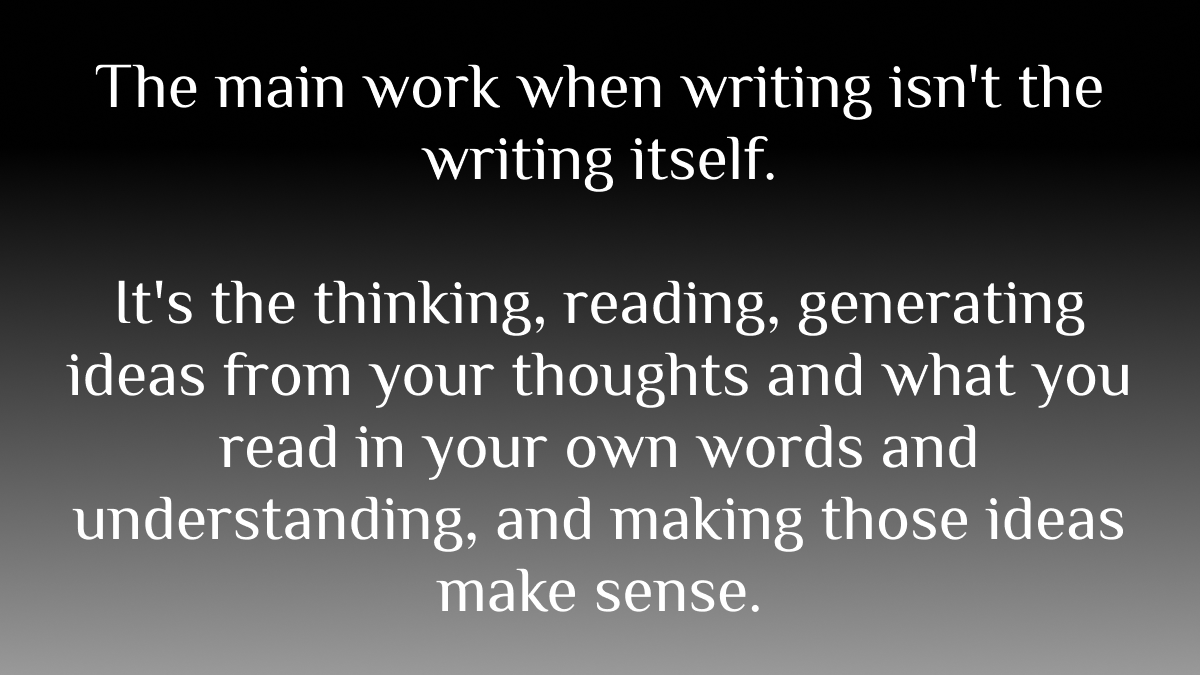
You can’t write because you don’t have ideas in your brain.
The best way to store ideas in your brain is to take notes.
But not just any other notes.
You have to take notes in a way that you understand the idea, not just memorize it how the author wrote it or the lecturer talked about it.
You'll know you've done it right when you sit down in front of a blank page and you already have a lot of things to write about.
Here's how:
1) Be Ready to Capture
Explore your curiosities and set your mind to have the intention of hunting for ideas.
Ideas will start flowing into you.
You must always be ready to capture it.
When reading a book or any resource
listening to a podcast
watching a YouTube video
having a conversation
or just a random thought that pops in your head as you go along your day
There are ideas that will come to you or stand out to you—write it down, capture those ideas.
But make sure you don't write it word by word exactly how you discovered it. Write it in your own words. Try to write it in a way that you're teaching someone else that has no idea about it.
This will make sure that you understand it, instead of you just memorizing it.
You don't have to make an entire section of an article right now. I want you to just write down for now what stuck out to you.
You can write anywhere.
Napkin
Notebook
Piece of paper
Note taking softwares (Kortex, Notion, Obsidian, Your phone's notes app, etc.)
Anywhere works, just pick.
2) Cook
Once a day, you go through the ideas you've captured and quickly skim through it.
Take note of the ideas that still resonate with you or that still piques your interests.
Remove the trivial ones, these ideas will come back to you if they really are important to you.
Now, from the ones that remains, flesh them out. Expand on them.
Think of:
Problems that can potentially come up from that idea.
Any goals and benefits.
Your personal experiences.
If you've solved a problem from it before, what's the solution or the process you applied?
Can you think of a concept from that?
After answering these, can you come up with a conclusion or a big idea from all these?
You don't have to answer all these. Just write out what comes to your mind.
If you've never done this before, you'll find yourself stuck a lot. It's normal, as you do this, you'll get better and you'll be able to think in this way easier over time.
3) Consume
This is the part where the dots that you can connect in your brain increases.
It's how you expand the knowledge in your mind.
This is the secret to being creative.
After fleshing out an idea, you have to add a tag on it to categorize it based on what the idea is all about. (e.g. if it's an idea that's about spirituality, just add a label on it somewhere where it says 'spirituality')
Make sure you store it somewhere where it won't be lost so you can reference it later on as you write. You can do this a lot easier on note taking softwares like Kortex, Obsidian, and Notion.
In the future, as you write about something related to spirituality (spirituality is just an example), you can then reference this fleshed out idea that you stored, connect it to the context of what you're writing about and add depth into your writing.
This is how you become creative and come up with original ideas.
Always be learning.
Keep consuming information and knowledge, but the most important thing is to follow your curiosity and interests.
If you're really curious and interested about something, it'll be natural for you to have questions in your mind, follow that path and see where it leads you. Take notes along the way, keep adding ideas into your memory bank.
The more you repeat this process every day, the more you expand your mind, the more you increase the dots you can connect.
You'll never be staring at a blank page ever again.
And if you want to create something useful or monetizable out of an idea that you hunt, learn how to be a creator. This letter here will teach you everything you need to get started.
Thanks for reading.
I hope this helped.
– James
Reply